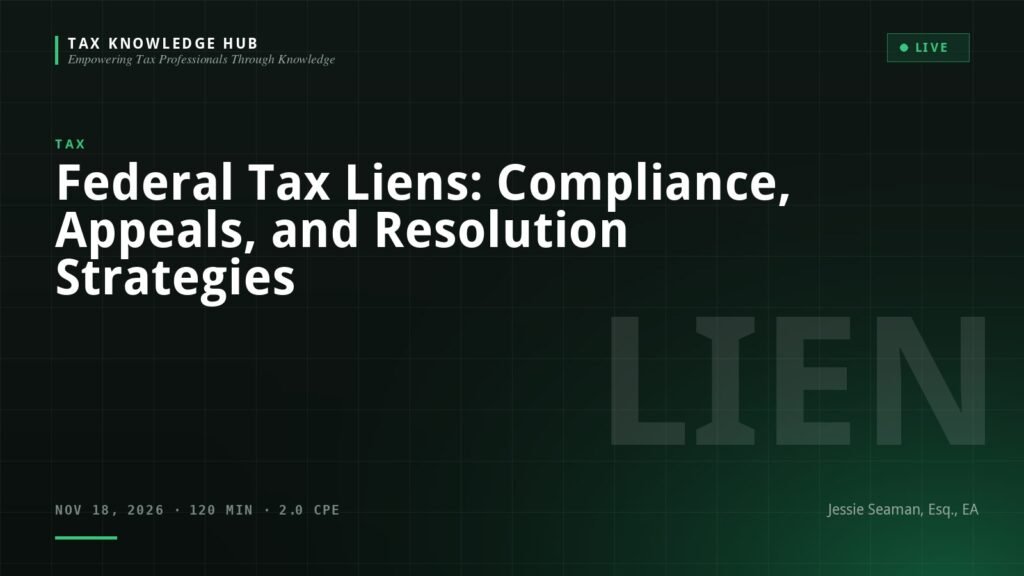
When a taxpayer has an outstanding tax debt, the IRS may impose a Federal Tax Lien, leading to significant financial and legal challenges. Understanding the complexities of federal tax liens is essential for tax professionals guiding clients through the risks and the resolution strategies available to them.
This instructor-led course provides a comprehensive overview of statutory federal tax liens, covering the conditions under which the IRS can file a Notice of Federal Tax Lien (NFTL) and the options available to taxpayers to prevent or modify its impact.
Key areas of focus include the fundamentals of federal tax liens and how they affect taxpayers, the IRS authority for filing an NFTL, taxpayer remedies and resolution strategies including subordination, discharge, withdrawal and release, advisory timelines and preventive measures, and appeal rights alongside the latest changes to credit reporting.
Learning Objectives:
After completing this session you will be able to:
01Identify the conditions under which a statutory federal tax lien is created.
02Explain IRS authority to file a Notice of Federal Tax Lien (NFTL) and the criteria for its issuance.
03Recognize available taxpayer remedies, including release, withdrawal, discharge and subordination of a federal tax lien.
04Explain the impact of an NFTL on a taxpayer or client, covering financial, legal and credit implications.
05Guide clients on how to prevent an NFTL, and determine which resolutions require a lien determination for proper handling.
Topics Covered:
Federal tax lien creation: the process and its legal basis.
IRS authority for NFTL filings: when and why the IRS can file a lien.
Taxpayer remedies and resolutions: subordination, discharge, withdrawal and release.
Impact of NFTLs on clients: financial, legal and credit-related consequences.
IRS lien appeal rights and credit reporting: navigating appeals and recent reporting changes.