Skip to content
+1-901-746-0281 (9am – 4pm EST) NASBA · IRS CE · APA · HRCI approved Login
Self Study Tax Session learning level: Update

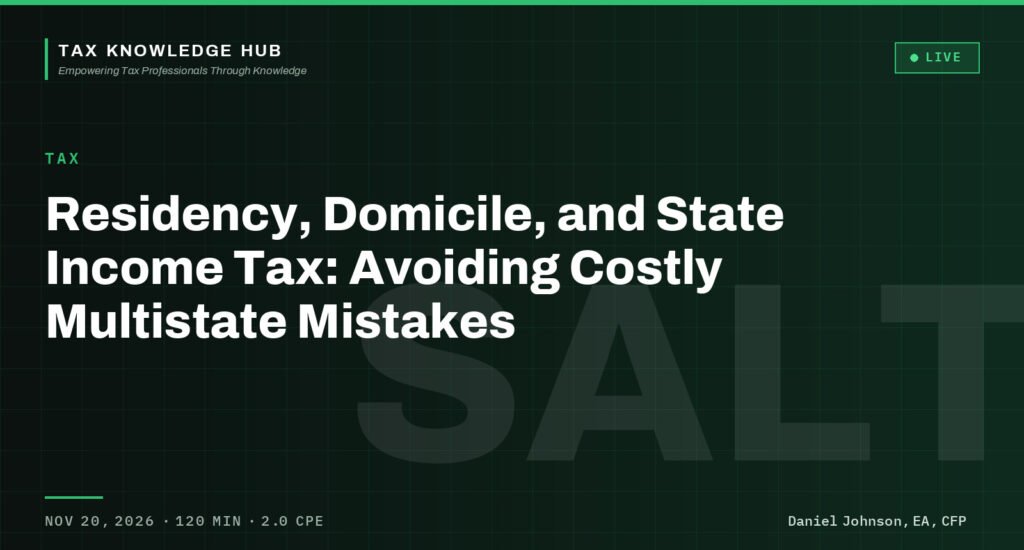
Residency, Domicile, and State Income Tax: Avoiding Costly Multistate Mistakes

November 20th, 2026 3pm ET | 2pm CT | 1pm MT | 12pm PT 120 minutes Daniel Johnson
Residency, Domicile, and State Income Tax: Avoiding Costly Multistate Mistakes
From
$169.00
3 delivery formats available
NASBA CPE2.0 hrsTaxesIRS CE2.0 hrsFederal Tax Law
Register now
Delivery methodGroup Internet Based
LocationVirtual / Online
PrerequisitesNone
Attendance requirementYes
Field of studyTaxes

Course Overview:

More taxpayers than ever are relocating to states with no personal income tax, working remotely across state lines, or maintaining homes in multiple jurisdictions. With that mobility comes significant state tax exposure: a client may believe they have changed residency, while a former state may still assert that they remain a domiciliary or resident for income tax purposes.

The financial stakes can be substantial. A residency challenge may result in additional state income tax, interest, penalties, amended returns, audit costs, and years of uncertainty. Tax professionals need more than a basic definition of domicile—they need a practical framework for evaluating facts, guiding clients before a move, and building documentation that can withstand state scrutiny.

This timely course provides a practitioner-focused review of the statutory and factual standards states commonly use to determine domicile and residency. Participants will examine the meaning of permanent abode, the greatest-connections analysis, and the practical steps clients should take before, during, and after a relocation.

Through real-world examples and audit-risk scenarios, attendees will learn how to advise clients who are changing domicile, evaluate potentially conflicting residency facts, and reduce exposure to residency disputes. The program emphasizes proactive planning, strong documentation, and practical strategies to help clients support their claimed state of residence.

Learning Objectives:

After completing this session you will be able to:

  1. 01Distinguish domicile from residency under state statutory provisions and explain why the difference matters for state income tax.
  2. 02Evaluate permanent-abode considerations and common fact patterns that create conflicting residency claims.
  3. 03Apply the greatest-connections analysis—days, homes, family, business, voting, licenses, and other ties—to a client's facts.
  4. 04Advise clients on the steps to take before, during, and after a relocation to establish domicile and residency in a new state.
  5. 05Identify the documentation, records, and contemporaneous evidence that support a residency position.
  6. 06Address part-year residency, nonresident returns, credits, and multistate filing issues.
  7. 07Recognize residency audit exposure, assessments, penalties, and appeal considerations, and avoid common mistakes that create unnecessary state tax risk.

Topics Covered:

  • State statutory provisions governing domicile and residency
  • The legal and practical differences between domicile and residency
  • Permanent-abode considerations and common fact patterns
  • Greatest-connections analysis: days, homes, family, business, voting, licenses, and other ties
  • Practical criteria for establishing domicile and residency in a new jurisdiction
  • Steps clients should take before, during, and after a relocation
  • Documentation, records, and contemporaneous evidence that support a residency position
  • Part-year residency, nonresident returns, credits, and multistate filing issues
  • Residency challenges, audit exposure, assessments, penalties, and appeal considerations
  • Common mistakes that create unnecessary state tax risk
  • Case studies and practical planning strategies for relocating clients

Credits & Information:

NASBA CPE 2.0 hrs · Taxes
IRS CE 2.0 hrs · Federal Tax Law
Recommended field of study
Taxes
Session prerequisites
None
Session learning level
Update
Location
Virtual / Online
Delivery method
Group Internet Based
Attendance requirement
Yes
Session duration
120 minutes

Who should attend

CPAsEAsand tax preparersTax attorneys and state and local tax (SALT) practitionersWealth managersfinancial plannersand family-office professionalsEstate-planning attorneysControllersCFOsand business advisorsIndividuals and families planning an interstate move or maintaining homes in multiple states

Speaker:

Daniel Johnson Advanced Planning Advisor - Focus Partners
EACFP

Dan is a Chicago-based financial professional, internal consultant, and advanced planning advisor at Focus Partners. He supports advisors on complex client cases, practice management, and specialized planning needs, while also leading internal…

View all courses by this speaker
Scroll to Top